Innovation in Materials Science
We are proud to announce that our research team – Fatemeh Mirsafi, Associate Professor Till Leißner, and Professor Yogendra Mishra – received the BHJ Innovation Award 2025 during last week’s ceremony ahead of Industry Day.
Their work tackles a critical challenge in modern electronics: efficient cooling for increasingly compact and powerful components. Traditional methods like fans or water cooling are reaching their limits. The team’s solution? Nanofluids – smart suspensions of engineered nanoparticles that dramatically improve heat transfer.
In proof-of-principle experiments, they achieved 15–20% higher thermal conductivity with ultra-low particle concentrations, paving the way for energy-efficient cooling in next-generation electronics for healthcare, environmental monitoring, and smart automation.
Congratulations to the team for bridging advanced nanomaterials research with real-world applications! 👏
FIB-SIMS arrived
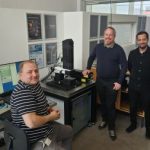
We’re excited to announce the arrival of our new Thermo Scientific Helios 5 DualBeam FIB-SEM-SIMS instrument, a major upgrade for NANOCHEM at SDU Sønderborg
This advanced system combines Focused Ion Beam (FIB) and Scanning Electron Microscopy (SEM) with secondary ion mass spectrometry (SIMS), enabling high-resolution 3D nanoscale chemical imaging.
With this new instrument, we can now:
🔹 Perform quantitative elemental and isotopic analysis below 50 nm
🔹 Generate 3D reconstructions of complex materials
🔹 Combine morphology, structure, and chemistry in one workflow
This addition strengthens NANOCHEM’s role in supporting academic and industrial collaborations in materials characterization.


Nanochem Consortium Meets Advisory Board in Sønderborg


On August 28, the Nanochem consortium welcomed its Scientific and Innovation Advisory Board to Sønderborg. The meeting gathered board members from academia and industry alongside the project’s steering and management teams.
The day began with an introduction to the NANOCHEM project by Till Leißner, Eva Arnspang Christensen, Jonathan Brewer, Jakob Birkedal Wagner, and Kjeld Pedersen, followed by presentations from Advisory Board members:
- Dorthe Berg Buciek (Danfoss)
- Gregor Hlavacek (Helmholtz-Zentrum)
- Lorenz Kienle (CAU Kiel)
- Dorthe Posselt (RUC)
- Esben Skovsen (AAU)
- Duncan Sutherland (AU)
- Bjarke Jørgensen (NEWTEC)
- Carsten Gundlach (DTU)
Discussions centered on experiences with research infrastructures, strategies for attracting users, and financial models for operating shared facilities. The meeting concluded with a laboratory tour at SDU and a joint dinner, providing further opportunities for exchange and collaboration.
We thank all Advisory Board members for their valuable input and look forward to continued dialogue as the project develops.
RAMAN Instrument Upgraded


Our WITec Raman microscope has recently received a significant upgrade.
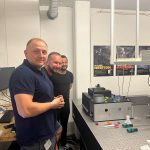
A new set of dark field objectives has been installed, providing improved contrast and imaging performance. In addition, the system is now housed in a custom-designed enclosure, offering better environmental control and improved safety.
The instrument is now fully operational and ready for use.
Optical sum-frequency laser installed @ NANOCHEM AAU
A tunable short-pulse laser system that is the heart of the SFG microscope at NANOCHEM has been installed at AAU. Test experiments demonstrate SFG using probe beams both in the range of electronic resonances and in the infrared vibrational spectroscopy range.
Sum frequency generation spectroscopy is a surface and interface sensitive process. It yields high detection efficiency with a signal in the visible region. The method can have high time resolution and resolve the molecular orientation. As different selection rules apply it is complementary to linear spectroscopy and Raman.
The setup requires two incident laser beams that penetrate the medium to investigate. The signal is generated when the frequencies match discrete states in the medium and a sum frequency signal is emitted in the direction of the sum of the wavevectors of the incident beams.
Find out more here.
BHJ Awards to our scientists

Just before Christmas, two of our scientists Jacek Fiutowski and Ayoub Laghrissi were recognized with BHJ Awards for their remarkable work:
🏆Young Researcher Award🏆
Dr. Ayoub Laghrissi shared the Young Researcher recognition with Dr. Ali Khosravi. Ayoub´s work focuses on:
- Pioneering chemical microscopy techniques for detecting nanoplastic particles in environmental samples, particularly water.
- Developing colloidal nanomachines for pollutant detection in water, advancing environmental monitoring and pollution control.
- Providing valuable insights into nanoplastics’ environmental impact and improving detection methods.
🏆 Innovation Award 🏆
Assist. Prof. Jacek Fiutowski received the Innovation Award together with Serkan Ayvaz, Krzysztof Sierszecki, and Casper Kunstmann, for their collaborative work on ‘Digitalisation in Environmental Monitoring’. Their achievements include:
- Developing advanced AI algorithms and smart sensors for improved water quality analysis and pollutant detection.
- Creating optical sensor technologies to enhance environmental assessments.
- Innovating digital and 3D-printed microfluidic systems for faster, more efficient sample processing.
Congratulations Ayoub Laghrissi and Jacek Fiutowski for these achievements!
New affiliated facilities
We’re proud to announce that we have 4 new affiliated facilities:
Ram Janay Choudhary Consortium for Scientific Research, India
NanoBioMedical Centre, Adam Mickiewicz University, Poland
Centre for Microcopy, Characterization and Analysis, University of Western Australia
Advanced Instrumentation for Nano-Analytics at LIST, Luxembourg Institute of Science and Technology
These centres are leading their national scientific infrastructures and we exchange with them on best practices and scientific progresses. We link to them in the upper menue.
NanoFTIR

We’re happy to announce that the NanoFTIR is installed in our labs! The instrument is ready for use.